Dispute Resolution
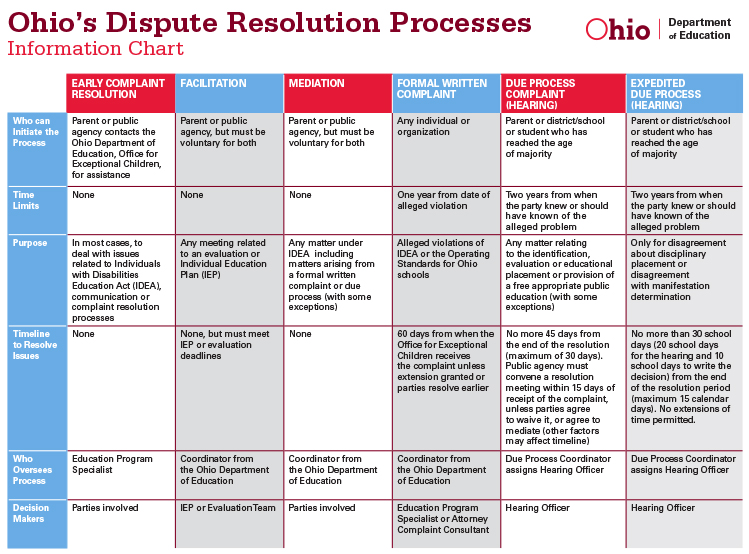 Situations may arise where parents or other family members believe a school has violated federal or state law. The Ohio Department of Education (ODE) Office for Exceptional Children (OEC) and Office of Early Learning and School Readiness (EL&SR) encourage parents, family members and schools to work together to resolve differences.
EARLY RESOLUTION
Early resolution is an informal process that may alleviate the need to file a formal written complaint or due process complaint. The Dispute Resolution section has an Education Program Specialist (EPS) available to provide further explanation about federal and state laws relating to special education, describe the dispute resolution options that are available to parents, inform parents of procedural safeguards, identify other agencies and support services, and describe available remedies and how parents can proceed.
Mediation
Mediation is a voluntary process for resolving disputes between two parties. For mediation to occur, both sides must agree to mediate. The mediation process is facilitated by a trained impartial third party, the mediator, who helps the parties communicate with each other about their concerns in an effort to reach a mutually acceptable solution.
Facilitation
Facilitation takes place in a team meeting such as an individualized education program (IEP) team meeting, evaluation planning meeting or an evaluation team meeting. The facilitator is a neutral, third party who is not a member of the team and does not make any decision for the team. Having a facilitator assists the team in being productive and keeping the focus on the student. Facilitators are professional mediators who have been trained by the Office for Exceptional Children in special education processes.
Complaints
ODE has instituted effective complaint investigation procedures, allowing issues to be resolved in a timely manner. ODE reviews written and signed allegations concerning violations of state or federal special education law. Below are links for information and the necessary forms for filing a complaint.
Due Process
Parents, school districts or other agencies (e.g., county boards of developmental disabilities, Department of Youth Services) may request an impartial due process hearing to resolve disagreements about the identification, evaluation and placement of a student or the provision of free appropriate public education (FAPE). The hearing is conducted by an impartial hearing officer who is appointed by ODE. Below are links for information and the necessary forms to request a due process hearing. The requesting party may use the form provided or may submit his/her own written due process complaint notice and hearing request.
Dispute Resolution Complaint Findings and Due Process Decisions Database
Legal Services for Low Income Ohioans
Related
Last Modified: 3/13/2024 3:16:19 PM